
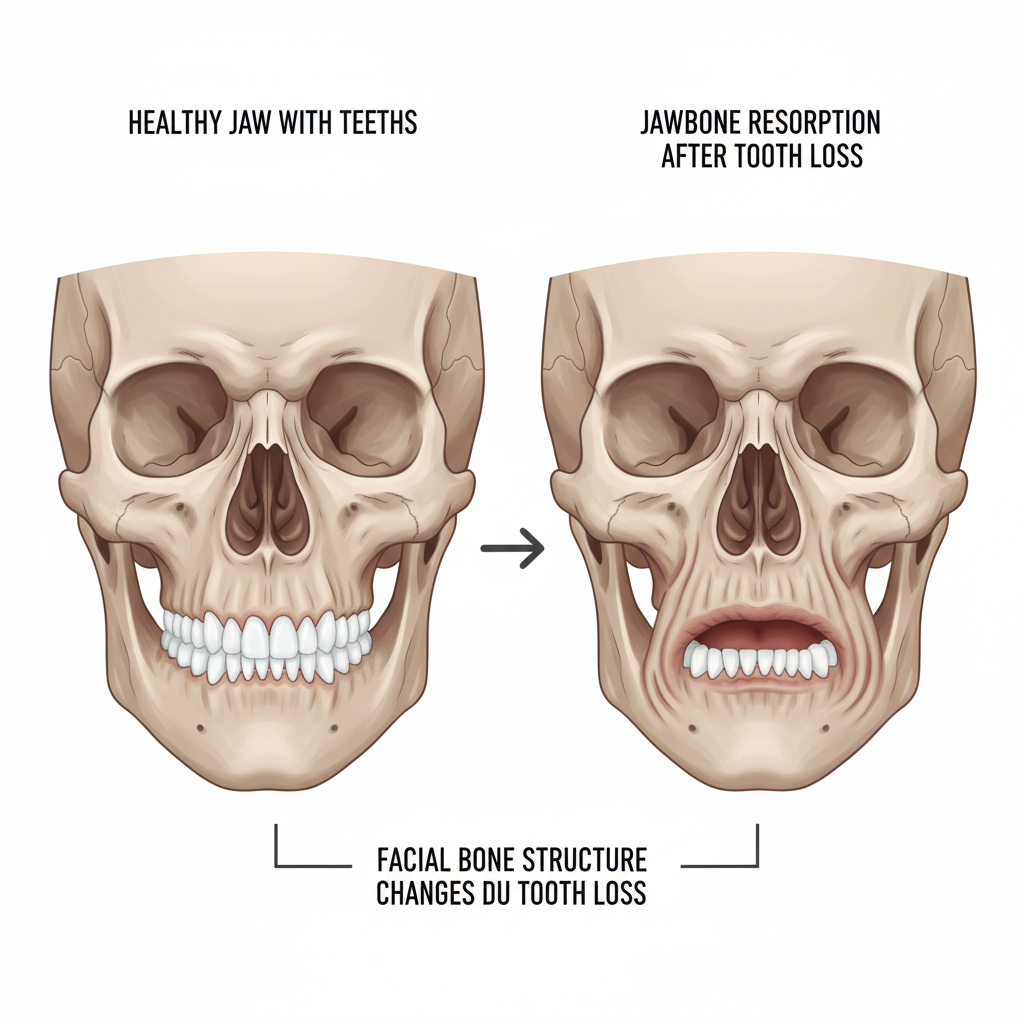
How Tooth Loss Can Change Your Face Shape
When people think about losing a tooth, the first concern is usually cosmetic: the gap in their smile. But tooth loss has consequences that go far beyond appearance. Over months and years, missing teeth trigger a chain of biological changes that can fundamentally alter the shape of your face, making you look older than your actual age.
This is not a scare tactic. It is straightforward biology, and understanding it helps explain why replacing missing teeth matters for reasons that have nothing to do with vanity.
The Connection Between Teeth and Facial Structure
Your teeth do more than chew food. They serve as structural supports for your jawbone, cheeks, and lips. Each tooth root sits in a socket within the alveolar bone, the ridge of bone that forms the upper and lower jaws. When you chew, the force transmitted through your teeth stimulates this bone, signaling your body to maintain its density and volume.
Remove the tooth, and you remove the stimulus. Without it, the bone begins to resorb, a process where the body breaks down bone tissue and reabsorbs the minerals. This is not a theoretical risk. It happens in every case of tooth loss, without exception.
The Timeline of Bone Loss After Tooth Loss
First 6 Months
The most dramatic bone loss happens immediately after extraction. Studies show that the alveolar ridge can lose up to 25% of its width within the first year, with the majority of that loss occurring in the first three to six months.
You will not see changes in your face yet at this point. The loss is happening beneath the gum tissue, invisible to the eye but measurable on X-rays.
1-3 Years
Bone resorption continues at a slower but steady pace. The ridge narrows and shortens. If you are wearing a removable denture or partial, you may notice it becoming looser as the bone beneath it shrinks.
Subtle facial changes may begin to appear. The cheeks above the missing tooth area may look slightly flatter or less supported.
3-10 Years
After several years of tooth loss without replacement, the changes become more apparent. Depending on how many teeth are missing and their location, you may notice:
- Sunken cheeks: Without the support of teeth and bone, the cheeks lose their underlying structure and begin to collapse inward.
- Thinning lips: The upper and lower lips lose the support provided by the teeth behind them. Lips appear thinner and the vermilion border (the distinct edge of the lip) becomes less defined.
- Deepened facial folds: The nasolabial folds (lines from nose to mouth corners) become more pronounced. Marionette lines (from mouth corners to chin) deepen.
- Reduced facial height: The lower third of the face becomes shorter as bone volume decreases, creating a more compressed appearance.
- Chin projection: The chin may appear to rotate forward and upward as the bite collapses.
10+ Years (Complete Tooth Loss)
Individuals who have lost all their teeth and wear conventional dentures for many years often develop a characteristic facial appearance sometimes described as a "witch's chin" profile. The lower face collapses significantly, the chin rotates forward, and the distance between the nose and chin decreases dramatically. This can age a person's appearance by 10-20 years beyond their actual age.
How Different Tooth Positions Affect Your Face
The location of missing teeth determines which facial changes are most noticeable.
Front Teeth
Missing front teeth cause the upper lip to lose support and fold inward. The lip appears thinner and the area between the nose and lip flattens. Smiling becomes self-conscious, and many people subconsciously change their facial expressions to hide the gap, further altering their appearance.
Back Teeth (Molars)
Missing back teeth reduce the vertical dimension of your bite. Your jaw closes further than it should, compressing the lower face. This is where the most dramatic aging changes occur: sunken cheeks, deepened wrinkles, and a shortened facial profile.
Multiple Missing Teeth
The more teeth you lose, the more pronounced the effects. Loss of teeth on one side can even cause facial asymmetry as the bone resorbs unevenly.
The Domino Effect: How Losing One Tooth Affects Others
A single missing tooth sets off a cascade of changes that put neighboring teeth at risk.
Shifting: Teeth adjacent to the gap begin to tilt toward the empty space. Teeth in the opposing jaw may over-erupt (grow longer) because they no longer have a matching tooth to bite against.
Bite problems: As teeth shift, your bite alignment changes. Uneven forces during chewing can overload certain teeth, leading to fractures, TMJ problems, and further tooth loss.
Increased decay and gum disease risk: Shifted, tilted teeth create new hard-to-clean areas where plaque accumulates. This increases the risk of decay and gum disease, potentially leading to more extractions.
One study found that people who lose a single molar and do not replace it have a significantly higher risk of losing additional teeth within the following ten years.
Replacement Options That Preserve Facial Structure
The good news is that modern dental treatments can prevent, halt, and in some cases partially reverse the bone loss and facial changes caused by missing teeth.
Dental Implants
Dental implants are the only tooth replacement option that actually preserves jawbone. The titanium implant post is surgically placed into the bone, where it integrates through a process called osseointegration. Once healed, the implant functions like a natural tooth root, transmitting chewing forces to the bone and maintaining the stimulus that prevents resorption.
Research consistently shows that bone around dental implants remains stable for decades, while bone under bridges and dentures continues to shrink.
All-on-4 Implants
For patients who have lost all or most of their teeth, All-on-4 dental implants provide a full arch of fixed teeth supported by just four strategically placed implants. This approach preserves bone across the entire jaw and restores facial structure in a way that conventional dentures cannot.
Dental Bridges
Dental bridges replace missing teeth by anchoring to the teeth on either side of the gap. While they restore appearance and function, bridges do not stimulate the bone beneath the missing tooth. Some bone loss will continue in that area over time.
Dentures
Dentures restore the appearance of teeth and provide chewing function, but they sit on top of the gum tissue rather than in the bone. They do not prevent bone resorption, and over time, the bone loss causes dentures to fit poorly, requiring relining or replacement.
Implant-supported dentures address this limitation by anchoring the denture to implant posts, preserving bone while providing the stability and comfort that conventional dentures lack.
Frequently Asked Questions
How quickly does your face change after losing teeth?
Bone resorption begins immediately after tooth extraction, with the most significant changes in the first six months. Visible facial changes typically become noticeable after one to three years, depending on how many teeth are missing and their location. Multiple missing back teeth cause faster visible changes than a single missing front tooth.
Can dentures prevent face shape changes?
Conventional dentures restore the appearance of teeth but do not prevent bone loss. Over time, the jaw continues to resorb beneath dentures, and facial changes will still occur. Implant-supported dentures are a better option for preserving bone and facial structure long-term.
Do dental implants really prevent bone loss?
Yes. Dental implants integrate with the jawbone and transmit chewing forces that stimulate bone maintenance. Studies show bone levels around well-maintained implants remain stable for 20+ years. Implants are the only tooth replacement that actively prevents resorption.
Can bone loss from missing teeth be reversed?
Once bone has been lost, it does not regenerate on its own. However, bone grafting procedures can rebuild lost bone volume before implant placement. Some regenerative techniques using growth factors show promise for restoring bone in areas of significant resorption.
At what age does tooth loss affect face shape the most?
Tooth loss affects facial structure at any age, but the effects compound over time. Older adults who have been missing teeth for decades show the most dramatic changes. However, a 30-year-old who loses multiple teeth and does not replace them will experience the same biological process.
How much do dental implants cost compared to the cost of facial aging?
While dental implants require a higher upfront investment than bridges or dentures, they are the only option that preserves bone long-term. When you factor in the cost of denture replacements every 5-7 years, bone grafting procedures needed later, and the quality-of-life impact of facial changes, implants often prove more economical over a lifetime. Contact Piedmont Dental at (803) 328-3886 for a personalized consultation.
---
At Piedmont Dental in Rock Hill, SC, we help patients understand their tooth replacement options and make informed decisions about their long-term oral health and facial appearance. Schedule a consultation or call (803) 328-3886 to discuss your situation.